Blog 01 – February 24, 2026
Lately, I’ve been more stoked on going to shows. Being present in a space, buying merch from the musicians themselves, going to new venues, seeing new faces, trying not to block people as a 6’2” audience member.
Two shows affirmed this feeling again: The Mars Volta (TMV) at Sacramento’s newest venue, Channel 24; and a reunited Black Eyes, touring their first album in 20 years at Berkeley’s legendary 924 Gilman Street, where the band last performed in 2003.
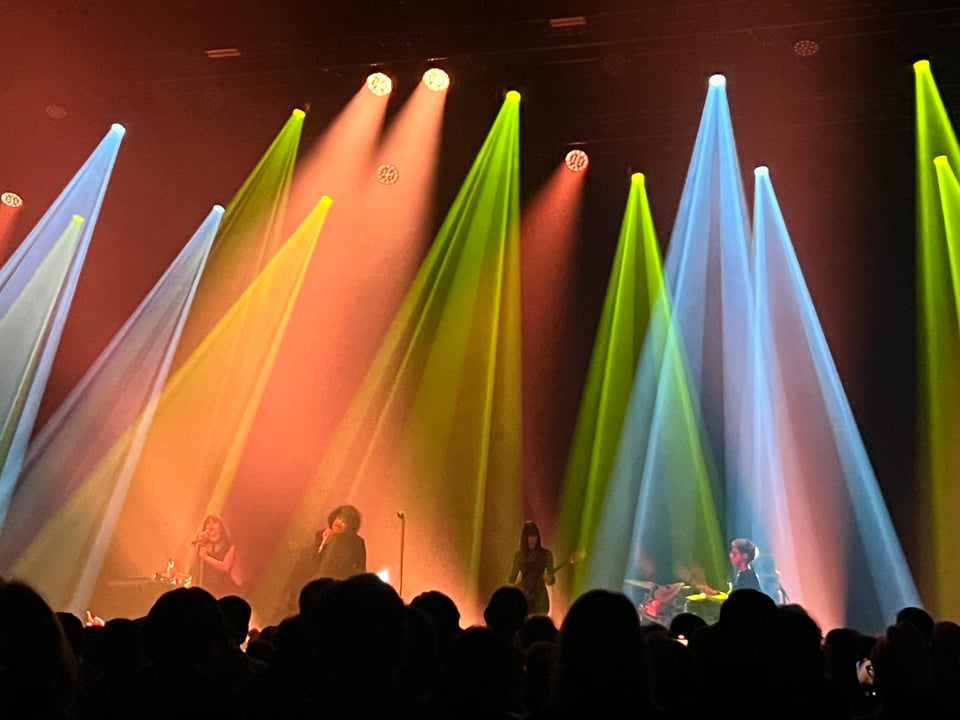
THE MARS VOLTA
The question that frequently underlies The Mars Volta is how they’ll execute their studio sound live, and with whom. Fans knew that, on this tour, the band would perform their new album Lucro Sucio; Los Ojos del Vacío in its entirety – and only those songs – no encore, no nostalgia, nothing but present tense.
Centered around the creative partnership and friendship of singer Cedric Bixler-Zavala and songwriter Omar Rodriguez-Lopez, the band rose from the ashes of their previous rock quintet, At The Drive-In, whose meteoric rise in 2000 and subsequent crash out in February 2001 led to the formation of The Mars Volta and Sparta, fronted by At the Drive-In co—founder, Jim Ward, and featuring ATD-I drummer Tony Hajjar and bassist Paul Hinojos, before he left Sparta and joined The Mars Volta in 2005.
I was lucky to bear witness to At the Drive-In’s final American tour stops at The Glass House in Pomona and The Palace in Hollywood in 2000. But I also saw Omar and Cedric’s other band, De Facto, in July 2001 at Chain Reaction, the all-ages venue in Anaheim (R.I.P). This was during that key post-ATD-I transition period, where Omar and Cedric rejected being rock’s next Nirvana and instead focussed on their experimental dub reggae band with Isaiah “Ikey” Owens (also known for solo project turned band, Free Moral Agents) and Jeremy Michael Ward.
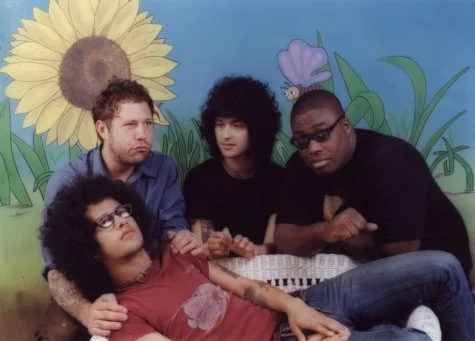
DE FACTO (left to right to front): Jeremy Michael Ward, Cedric Bixler-Zavala, Ikey Owens, Omar Rodriguez-Lopez.
De Facto were the antithesis of At the Drive-In: Jeremy’s garbled, vocal-effected shards of lyrics swoon over dub riddims from Omar and Cedric, while massive gospel-sized organs and keyboard wizardry emits from Ikey’s multiple setups. All groove and dance, no mosh or thrash, with Omar on bass, not guitar, and Cedric on drums, not vocals. Through At the Drive-In’s relationship with Grand Royal Records, De Facto put out a handful of singles through the Beastie Boys’ Capitol Records imprint and two albums for Omar and Sonny Kay’s Gold Standard Laboratories (GSL) label.
This popular 2002 bootleg of a free show at Lincoln Park in Long Beach, featuring a cameo by John Frusciante of the Red Hot Chili Peppers, is a good De Facto primer:
The four members of De Facto became the core of The Mars Volta when it formed in 2001, with Omar moving back to lead guitar and songwriting, Cedric to vocals, Ikey still on keys and Jeremy now manipulating the sound of the entire band, offstage, from the sound booth. Jon Theodore on drums and bassist Eva Gardner rounded out the rhythm section. By the end of 2001, TMV released a handful of MP3s and began touring.
I saw this original lineup that year on a bill between Mates of State and The Anniversary at the now-closed House of Blues, Anaheim in Downtown Disney. I was a senior in high school. I don’t think the crowd knew what to expect considering that Mates of States, a lovely and inherently cute duo of pop love songs with a lot of keyboards and harmonized sing-along moments, preceded this hyped new post-ATD-I band.
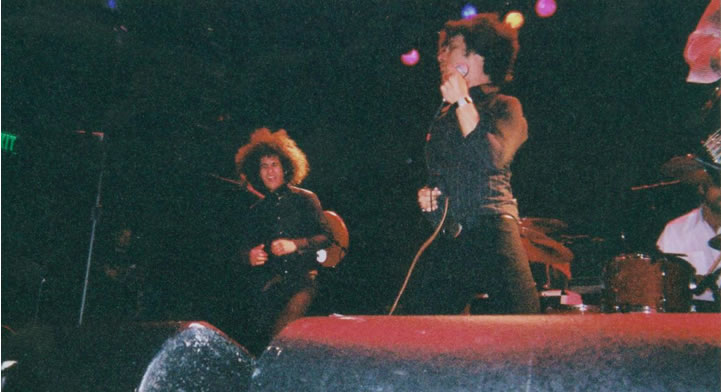
That TMV lineup was chaotic as hell and beautiful. I had never seen a drummer more skilled and terrifying as Jon Theodore. Each movement of Omar’s hips was a fuck you to the stiffs, playing while clapping, dancing, and lashing his guitar around his neck, letting the feedback swell before original rare songs like “Caught in the Sun” took flight.
The band would rise to Grammy-winning heights, beginning their journey with their well-received debut album, Deloused in the Comatorium, in 2003, released shortly after the overdose and death of friend and bandmate, Jeremy Ward.
Ward’s downward spiral is one of many heartbreaking moments detailed in Omar and Cedric: If This Ever Gets Weird, a documentary culled primarily from footage Omar shot himself over the course of his life, that was then presented to director Nicolas Jack Davies to assemble into a film, along with family footage and third-party live performances.
This honest rendering is also a reckoning, however biased by the auteurs, and the survival of bands like The Mars Volta as a representation of their relationship and friendship — from childhood El Paso punks, fighting racism in the scenes where many found salvation, to overnight successes that pulled the plug at their peak.
The film details Cedric’s immersion into Scientology, and the horrific incidents that propelled his and his family’s departure. Omar’s romantic relationship with Jeremy Ward is revealed, and a detailed account of Ward’s struggles with addiction. Omar and Cedric admit their egos were their Achilles heels, including the dismissal of original TMV drummer Theodore and Eva Gardner, their original bass player who reunited with the band in 2023. Many of the premises behind the stories of albums like Frances the Mute were myths used for promo. The untimely 2014 passing of Ikey Owens while on tour with Jack White in Mexico is also a pivotal moment in the film, and Omar and Cedric’s life.
I bought Omar’s photography book “Hunters in High Heels” at the Sacramento show partly due to the documentary, which was hard not to think about waiting for them to hit the stage. What Volta would we find now, in 2025 Sacramento?
FELIZ Y DADA
But before TMV took the stage, early arrivals got to experience openers Feliz y Dada, two aliens in masks, fronted by another alien, who not only wields a microphone while looking like a goth Predator, but occasionally made calls on a rotary telephone while gnawing on a rubber fish.
The soundtrack was gloomy, head-nod-inducing synth beats wardrobed in a velvet coat of industrial darkness; the soundtrack to a midnight goth-meets-punk rave in a rain forest, possibly El Yunque in Puerto Rico (a black and white version of the Puerto Rican flag considered a symbol of resistance to colonial American policies heightened by the PROMESA federal oversight board in 2016 was on stage all night). The spectacle seemed engineered to make you, audience beholder, shake thy ass as much as the two aliens who performed by hovering their hands over illuminated ‘instruments’ that lit up like a game of Sorry or a KAOSS pad made by Mattel. Playing or play-acting, it didn’t really matter, they were fun and performing on the right side of self-absorbed and ridiculous, occasional tongue flicking through their masks be damned (guess it’s a Martian thing). The singer, in full autotune, talk-sung jilted love songs with the vengeance of a karaoke addict from another galaxy, confused by our puny, civilian matters of the heart.
Feliz y Dada stay committed to the bit in the digital space too, with their only music currently available on YouTube via a series of music videos: a full-costumed arrival-on-earth vacation across southeast Asia (“Deadbolts”); a mischievous spy thriller involving gold vomit (“Drown in the Thames”).
I ran into my friend Gio before the set, who hipped me to the rumor that the alien duo were two of Omar’s biological brothers, with the singer, possibly female-identified, still unknown. Transparency be damned, Feliz y Dada’s twenty-minute set smashed the crowd over the head, immediately answering the question of what to expect at a Volta show in 2025.
There was a humility to The Mars Volta’s set that began with the stage position of Omar, playing comfortably in the back-center of the stage, opposite bassist Eva Gardner. We’re talking about an Omar that released a 57-LP box set of solo recordings in 2023 still available for a mere $1500 USD — there is no end to his capacity for centralizing himself as Art. Yet Omar was not front stage-right, but tucked away in the literal shadows towards the rear of the stage, with his brother, percussionist and multi-instrumentalist Marcel, taking more of the stage real estate. Singer Teri Gender Bender — a founding member of Le Butcherettes who also collaborates with Omar in several bands, including Bosnian Rainbows — provided backing vocals with Cedric, the two harmonizing much of the night’s set.
It was shocking to hear, in 2025, a Volta chorus as straight forward as “You’re the one that I want / the only one that I want.” But considering their previous songs were literally made up words frequently crafted by Jeremy Ward (including a personal favorite song title and jam, “Eriatarka”), to understand the simplicity of this lyric is to also understand the trajectory that led to it, perhaps referred to in Cedric’s “Ten-thousand phantoms rush through me / And I know I’ll regret it / If you have watched me mid-eclipse / Then you should know that it’s not safe inside my mind.”
Cedric himself appeared to have a large screen monitor with lyrics in front of him. Previous Cedric stage maneuvers, like stallion kicks and scorpion crawls across the stage in boots and tight denim, seem incongruent to this project and this incarnation of The Mars Volta. Compared to their original makeup, this was a recital, but one done with a confidence of knowing how to represent themselves today, sonically. Their sound is an appreciation of executing their idea of who they are, right now, through this lush performance of their latest album.
The sense of appreciation was palpable in Cedric’s closing remarks that night, thanking attendees for being cool to them, and more importantly, the openers Feliz y Dada and Kianí Medina:
BLACK EYES
In January, my friend Cole invited me to see the recently reformed D.C. post-punk group, Black Eyes, on tour for their new album, Hostile Design, released on Dischord Records and produced by Ian MacKaye across a handful of days near the November 2023 elections. ICE hadn’t shot and killed Renée Good, Keith Porter Jr, and Matt Pretti yet, nor had this increasing array of private detention centers been built at the time when Black Eyes recorded this record, yet this album sounds like the sense of rage that has consumed me this past year and a half of this current administration’s violent, homicidal tactics.
The album’s standout song “Burn” is a punk explosion wrapped inside a dub riddim, meandering the listener into a groove, sung in Greek by bassist Hugh McElroy:
“Πλούσιοι και φτωχοί πεθαίνουν
Και στο ίδιο χώμα μπαίνουν
Πλούσιοι και φτωχοί πεθαίνουν
Μόνο οι αναμνήσεις μένουν
Translation:
Rich and poor die in the same way
And go down into the same clay
Rich and poor die just the same
Only memories even remain”
…before guitar-basher and vocalist Daniel Martin-McCormick kicks off his verse performed simultaneously against McElroy in Martin-McComick’s signature, unhinged prose:
[Daniel Martin-McCormick, Hugh McElroy]
“Kill your shitty parents, let their blood flow free
(You could tell that I wanted to leave, but)
Across the hot concrete
(You did it anyway, you did it anyway)
C’mon, kill your shitty parents, last year’s waste accumulates
(You could tell that I wanted to live, but)
In gutters and streams
(You did it anyway, you did it anyway)”
The verses become spoken word treatises against those generations unable to change, a death rattle for boomers amplified through the delay-pedal-echo of a steel drum shoving its way towards the chorus. The title of the track is screamed as the chorus, with each “BURN” curdling that much more of the listener’s blood, followed by a specific-as-fuck summary from Martin-McCormick:
“In every possible respect,
you’re getting left behind
Eat shit,
there’s no way to press rewind”
In an era where Green Day opened the Super Bowl nearly a year after headlining Coachella, where the Circle Jerks also played on a smaller stage, and to experience this song, at Gilman, during this political climate, made the idea of punk sonically tangible for me in a way I haven’t experienced in quite some time.
More of their new album was explored, with saxophonist Jacob Long’s play increasingly dynamic throughout the night. When older songs like “A Pack of Wolves” got the crowd going, some even stage diving under the sign that says “No Stage Diving; No Insurance = No Gilman”, and a small circle pit opened up from the same familiar suspects, the Black Eyes’ Hugh reminded people of our current times and the need to treat one another with kindness, even if that means not smashing the people closest to the stage in order to mosh in a circle pit. How places like Gilman are where we can treat each other with the love most of society does not.
It is easy to connect the dots between this act and their producer Ian MacKaye’s band Fugazi who would infamously pause shows to check people’s behavior, including kicking people out. Hugh’s uplifting chiding was a teaching moment that I’m sure made those actual parents — whether accompanying or dragging their kids to the show — more assured that their kid(s) was on the right side of East Bay third spaces, dry snack bar included.
I was thankful to see a band care — about the space, their sound, their chaotic, frenetic, controlled delivery — and to bear witness, knowing how quickly any of these things can change.
 José Vadi